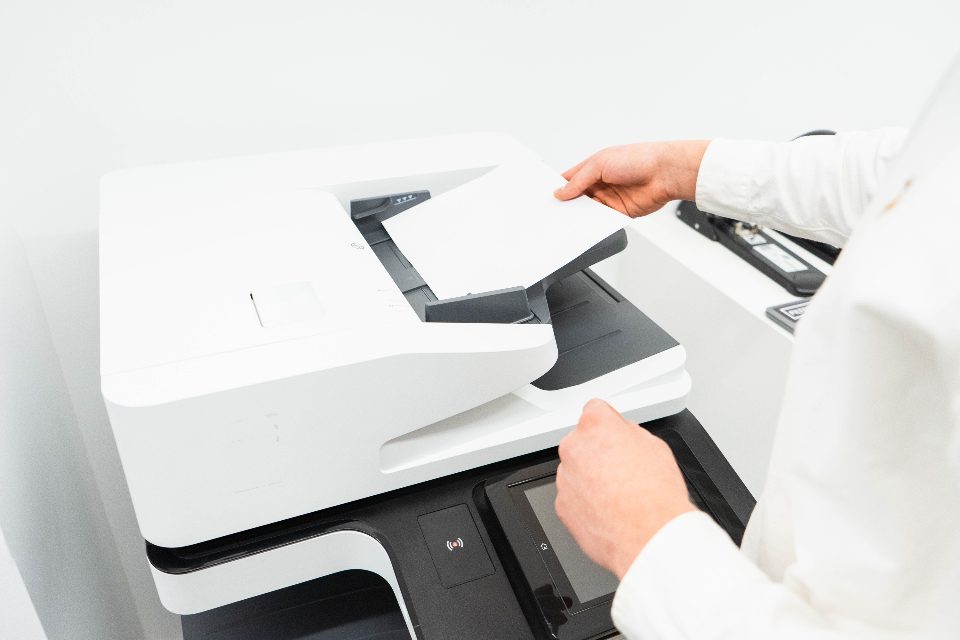
Short answer: To automate fax referral intake, route every inbound fax to a digital queue, use OCR and an AI model to sort each document and pull out the patient, insurance and referral details, then pre-fill the referral in your EHR for a coordinator to check and approve. AI handles the reading and sorting, while plain rules handle matching, missing-field checks and routing. The coordinator stays in charge of anything clinical and anything the system is unsure about.
The problem
Most specialist practices still receive a large share of new patient referrals by fax. They arrive as eFax PDFs or printed pages: a cover sheet, a referral letter, a face sheet, an insurance card scan and a few pages of notes, often in a different order every time and sometimes barely legible.
Someone has to open each one, work out what it is, find or create the patient in the EHR, type in demographics and insurance, create the referral and decide what happens next. When referral details are missing, they phone the referring office. Meanwhile the queue grows.
It is not just a US habit. In a Hacker News discussion, one commenter described being surprised by how many Australian practices still fax reports and referrals, largely because ordinary email isn't trusted for confidential patient data. When a startup in this space launched on Hacker News, its founders described the intake job in the same terms clinic staff do: reading referral documents, chasing primary care offices for missing information and checking insurance cover before the patient can even be booked.
The numbers back this up. ONC's February 2026 presentation of American Hospital Association survey data shows that around eight in ten US non-federal acute care hospitals still received patient health information by mail or fax in 2025, slightly more than in 2018, even as electronic exchange grew. The UK government banned the NHS from buying new fax machines in December 2018 after finding more than 8,000 still in use in England, which tells you how hard the habit is to break.
What it costs
The best public measurement we found comes from UCSF. In a 2020 JAMIA Open paper, its team timed manual referral intake at a central access centre and found it took 719 seconds per referral on average, roughly 12 minutes. At the time, 47% of UCSF's incoming consult referrals arrived by fax, and one specialty reported a queue of 450 referrals with each full-time staff member getting through about 30 in a working day.
Not all of those 12 minutes are typing. In the same study, the steps that were pure data entry (looking up the patient, updating demographics, updating insurance, creating the referral and logging it) added up to just under four minutes. Calling the patient took about three minutes on average, and calling the referring office for missing information took nearly four minutes when it happened.
That split matters, because it tells you what automation can realistically save. More on that below.
The less visible cost is delay. A referral sitting in a fax queue for days is a patient not being booked, and a slot on a specialist's calendar not being filled.
Why it keeps happening
Fax survives because it works well enough for the sender. Every referring office has a fax number, there is no integration to set up, and faxing is widely accepted for sending health information in a way ordinary email often is not. The burden falls on the receiving practice.
EHRs don't fix it on their own. Most can store a fax as an attachment, but turning the content into structured fields still needs a person. Referral forms vary by sender, so a template that reads one clinic's form breaks on the next. UCSF's own tool used OCR with form templates, and the authors noted that each template takes upfront work to build.
Volume also creeps up quietly. A practice adds a provider or a location, referrals grow by a third, and nobody adds a coordinator until the backlog is already a problem.
How AI solves it
The aim is a pipeline where software does the reading and pre-filling, and people do the checking and deciding. Here is the workflow we would build for a typical specialist practice.
1. Capture every fax in one place
Point all fax lines at a cloud fax service or a shared eFax inbox that saves each fax as a PDF. This is plain automation: a watcher picks up each new file and creates a work item. No AI is needed yet.
2. Read the pages
OCR turns the scanned pages into text and, where possible, into form fields and tables. Cloud OCR services such as Amazon Textract charge per page. Handwriting and poor fax quality are where OCR struggles, so the system should keep a confidence score for each field.
3. Split and classify the bundle
One fax often contains several documents. An LLM is good at this step: given the OCR text, it can label pages as cover sheet, referral letter, insurance card, clinical notes, lab results or "not a referral" (records requests and marketing faxes land in the same queue). Non-referral documents get routed to the right inbox automatically.
4. Extract the fields
The LLM pulls out patient name, date of birth, contact details, insurance plan and member ID, referring provider, reason for referral, urgency and the requested specialty. It returns them in a fixed structure, along with the page each value came from, so a reviewer can check it in seconds.
5. Check with rules
This part should not be AI. Plain rules decide whether a referral is complete:
| Check | Done by | Why |
|---|---|---|
| Is the patient already in the EHR? | Rules (match on name plus date of birth) | Deterministic, auditable |
| Are required fields present? | Rules | Your intake checklist, written down once |
| Is the insurance plan one you accept? | Rules plus a payer list | Simple lookup |
| Is it urgent? | LLM flags wording, a person confirms | Clinical judgement stays human |
| Which provider or clinic should see it? | Rules from your routing table | Predictable and easy to change |
6. Pre-fill and queue for review
Complete referrals are pre-filled in the EHR (through its API, an integration engine, or as a last resort an RPA bot) and land in a coordinator's queue with the source fax beside them. The coordinator checks, corrects and approves. Incomplete ones generate a draft request to the referring office listing exactly what is missing, which the coordinator sends with one click.
7. Measure it
Log how often each field was corrected, how long review took and how many referrals went straight through. UCSF built this tracking into its design, and it is the only honest way to know whether the system is earning its keep.
Costs and timeline
These figures are estimates for illustration. Your volumes, EHR and page counts will change them.
Assumptions: a specialist group receiving 40 faxed referrals per working day, 21 working days a month (840 referrals), five pages per referral (4,200 pages a month), and the UCSF figure of just under four minutes of pure data entry per referral.
- Data entry time today: 840 × 4 minutes is about 56 hours a month, before any time spent sorting, reading and chasing.
- With automation: if review of a pre-filled referral takes about one minute, that drops to around 14 hours, saving roughly 42 hours a month. Some sorting and reading time would also go, but we have not counted it.
- OCR cost: at Textract's listed price of $0.0015 per page for basic text detection (US West region, first million pages), 4,200 pages is about $6 a month. Using form extraction on every page at $0.05 per page would be about $210, so most builds use the cheaper option plus an LLM.
- LLM cost: depends on the model and page length; for this volume we would expect tens to low hundreds of dollars a month. Treat that as a rough estimate.
The bigger costs are building and maintaining it.
| Option | Typical cost (estimate) | Timeline | Fits when |
|---|---|---|---|
| Do nothing | Staff time plus booking delays | n/a | Low volume, one EHR, no backlog |
| Off-the-shelf fax or referral tool | Subscription, often priced per user, location or page | Weeks | Your EHR is supported and your referrals are fairly standard |
| Custom build | Our rough estimate is $20,000 to $60,000 for a first version, plus ongoing support | 6 to 12 weeks to a working pilot | Several EHRs or clinics, unusual routing rules, or tools that don't fit |
The build range assumes one EHR integration, a handful of referral types and a review screen. A second EHR, a complex prior authorisation step or on-premises hosting would push it up.
When not to use AI
If you receive fewer than ten faxed referrals a day, the time saved may not justify a project. Tidying up the manual process first (one shared queue, a written intake checklist, a standard request-for-information template) often recovers more than you expect.
If your EHR vendor already offers fax classification and pre-fill as an add-on, try that before building anything. You will get less control, but you also skip the integration work.
If your referring partners can send electronic referrals through your EHR or a health information exchange, push for that. Structured data at the source beats extracting it from a fax.
AI should not make clinical decisions here. Triage of urgency, medical necessity and whether to accept a referral need a clinician or a trained coordinator. Use the model to surface information, never to approve or decline.
Compliance comes first. In the US, any cloud service handling protected health information needs a business associate agreement in place. AWS's HIPAA page describes its BAA as required under HIPAA rules and says PHI should only go into the services the agreement covers. The same applies to any LLM provider you use. In the UK, EU and Australia, health data has extra protection under data protection law, so involve your data protection lead before you start.
How to start
- Count a typical week: how many faxes, how many are referrals, how many pages each, and how long intake takes per referral.
- Write down your intake checklist and routing rules. If they only live in a coordinator's head, this step alone is worth doing.
- Check what your EHR and fax provider already offer, and whether your EHR has an API for creating referrals.
- Confirm which vendors will sign a BAA (or a data processing agreement outside the US).
- Run a pilot on one clinic or one referral type for four to six weeks, measuring corrections and review time against your baseline.
If you want help scoping or building the pipeline, our AI workflow automation service covers intelligent document processing like this, including EHR integration and review screens. The same read, check and route pattern appears in our guides to automating COI tracking and AI order entry for distributors, if you want to see how it works in other industries.
FAQ
Can AI read handwritten fax referrals?
Partly. Modern OCR and vision models read neat handwriting reasonably well, but faxed handwriting is often low resolution and smudged. A well-built system flags low-confidence fields for a person to check instead of guessing.
Is it HIPAA compliant to use AI on faxed referrals?
It can be, if every service that touches patient data is covered by a business associate agreement and configured to match it. That includes the fax service, OCR, the LLM provider and any storage. Check the vendor's list of covered services, not just its marketing page.
How long does it take to process a faxed referral manually?
UCSF measured an average of about 12 minutes per referral at one of its central access centres, of which just under four minutes was pure data entry into the EHR. Your figure will differ, so time a sample of your own referrals before estimating savings.
Can faxed referrals be added to the EHR automatically?
Yes, if your EHR exposes an API or accepts data through an integration engine. UCSF built its tool as a SMART on FHIR app inside its EHR. Where no API exists, robotic process automation can fill screens, but it breaks more easily when the EHR changes.
Will this replace our referral coordinators?
It shouldn't. The goal is to remove typing and sorting so coordinators can spend their time on incomplete referrals, phone calls to patients and anything that needs judgement. Practices with a backlog usually find that work expands to fill the time saved.
Sources
- Odisho A. Y. et al., "Design and development of Referrals Automation, a SMART on FHIR solution to improve patient access to specialty care", JAMIA Open, 2020: https://pmc.ncbi.nlm.nih.gov/articles/PMC7660949/
- Office of the National Coordinator for Health IT, "Progress on Interoperability and Ongoing Improvements" (February 2026, American Hospital Association IT Survey data): https://healthit.gov/wp-content/uploads/2025/09/2026AnnualMeeting_Progress-on-Interoperability-and-Ongoing-Improvements.pdf
- GOV.UK, "Health and Social Care Secretary bans fax machines in NHS" (9 December 2018): https://www.gov.uk/government/news/health-and-social-care-secretary-bans-fax-machines-in-nhs
- Amazon Textract pricing: https://aws.amazon.com/textract/pricing/
- AWS, HIPAA compliance: https://aws.amazon.com/compliance/hipaa-compliance/
- Hacker News, "Launch HN: Cenote (YC W25), Back Office Automation for Medical Clinics" (March 2025): https://news.ycombinator.com/item?id=43280836
- Hacker News discussion on fax use in Australian medical practices (November 2024): https://news.ycombinator.com/item?id=42167952
If you'd like to talk through your own referral intake process and whether to build or buy, get in touch at https://sintraflow.com/contact.